
Weight loss is about healthy eating,
not about miraculous diets
Fitness Classic Nutrition Dilemmas Exercise Ideas
Strength Training Healthy Mind Fitness Opinions Archive
THE CRUMBLED PYRAMID
 The famous Food Guide Pyramid, introduced by the U.S. Government in 1992, has crumbled after a decade of celebrated existence.
It simply does not seem to work, given the quickly growing number of overweight and obese persons, as well as the number of diseases associated with obesity.
The Pyramid's main mission: to produce a fit, healthy and happy society obviously failed on all fronts.
Although not many people have strictly followed the Pyramid's advice, it may still be responsible for having sent a wrong message: avoid fat and you will be slim and healthy.
We, at Fitness Classic, have always been uneasy about the large amount of bread, cereal, rice and pasta allowed by this system (up to 11 servings a day).
Experts trying to construct new Pyramids seem to be of a similar opinion. They recommend fewer servings of mainly whole grain products, while moving pasta and even rice to higher floors of the structure. At the same time, healthy plant oils move downstairs.
THE NEW PYRAMID
 Well, in 2005, the USDA introduced a new pyramid, diplomatically avoiding the above, too dramatic depiction of suggested foods and specific levels of consumption.
Unfortunately, more and more experts believe that the new system is fun to play with, but, to put it mildly, it has a few defects.
If you want to translate your custom recommendations into meals, some nutritionists say, you'll need to take your measuring cups and a calculator to eat.
The new pyramid provides a flood of information, recommending portion sizes down to fractions of an ounce. But it doesn't take into account such essential information as an individual's height and weight. So, it has gone from being so simple that it doesn't say anything, to being so complicated that it's not useful.
ZiGzAgGiNg
We suggest to some of our clients the zigzag approach practiced by advanced bodybuilders. They have to eat a lot, if they want to build massive muscles, which means often an unwanted accumulation of fat, next to quickly developing muscles. There is no compromise: diminished food intake will stop muscular growth. Bodybuilders' response to this problem is "zigzagging" or alternating muscle building periods with fat loosing periods. In the first period eating is not limited in any way, while in the second period athletes accept serious food limitations.
Some persons entering a lifestyle change may benefit from a similar approach, particularly if limited eating puts on them a considerable distress. The perspective of occasional "vacations" from the new way of living can make them less downhearted and more determined to stay within the general course of transformation.

Don't worry that everything you eat contains calories. After all, everything you do burns them.
THE MOST FREQUENTLY ASKED WEIGHT LOSS QUESTION:
Why is it so hard to shed those pounds?
Different experts will give you different answers, sometimes very elaborate, but the truth is very simple. The main reason why 98 out of 100 dieters fail at losing weight is because their diets ignore "the logic" of human physiology. When you cut down your food intake for more than three days in a row on a strict weight loss diet, your body mistakes this as a sign that you are starving: that there is a limited food supply in your environment.
Consequently, your metabolism decreases to conserve energy and to store as much fat as possible. This makes it much more difficult to lose weight. Also, when you go off your diet, your metabolism is so slow that anything over approximately half of what you used to eat before you started dieting will cause you to gain weight again. In short, most weight-loss diets have built in a failure mechanism that causes a discouragingly low success rate.
 FAST WEIGHT LOSS PROGRAMS
AND YO-YO DIETING
Many weight loss programs offer fantastic results, such as losing weight at the pace of five pounds a day, forty pounds in the next three weeks, etc. We see those promises in countless advertisements on the Internet and elsewhere.
We advise caution. No weight loss diet can really succeed if you shed the pounds too fast. Most experts recommend losing no more than two pounds a week.
When you starve your body of fuel, it responds by slowing down your metabolism. Suddenly, even the smallest meals begin increasing your fat reserves. If you respond by cutting back further, you may lose weight again but then your body gives itself a better tune up and burns food even slower. That makes things even worse and you become a "yo-yo dieter". Do your best to avoid this vicious circle!
LOSE FAT NOT WATER
Can you lose five pounds in one day, as some weight-loss programs promise? Take a look at this calculation: One pound of your fat reserves contains 3,500 calories. To lose five pounds of fat you must burn 17,500 calories. Even if you didn't eat anything for 24 hours, you could hardly lose one pound. Even if you practiced exercises burning a lot of energy, such as martial arts or swimming you would have to train non-stop for 25 hours to lose five pounds of your fat. The only way to lose weight at the pace of several pounds a day is by drastic dehydration and that can be deadly dangerous!
Daily weight fluctuation is a result of water retention. Your body is made up of 2/3 water. On the days it holds more water, the scale will say you weigh more; on the days it is holding less water, the scale will say you weigh less. Misleading weight loss programs use rapid water weight loss to make you think their program is working. They only emphasize the quantity of your weight not the quality of your weight. To get a more accurate idea of how much you weigh you need to view your progress in terms of body fat and lean muscle mass.
FEEDYOUR BODY, NOT YOUR EMOTIONS

Most of those with overweight or obesity problems do not feed their bodies. They feed their emotions, moods, fears, disappointments, setbacks. Reaching for food under stress or in distress is not much different from reaching for alcohol in similar situations.
The very realization: my body does not need this additional food, only my mind and emotions do - may help. Unfortunately, most overweight persons start weight loss oriented "diets" without any prior analysis of their problems. A rigid food regimen becomes another stress calling for the same old remedy: bingeing on food; and the vicious circle closes.
That's why Fitness Classic does not believe in stiffly designed weight loss diets. You will feel much better by changing your eating habits step by step; by challenging yourself, playing games with yourself, forgiving yourself lapses and relapses; by moving towards your goal via many different roads, instead of that boot-camp-drill path imposed on you as a "miraculous" or "revolutionary" weight loss program.
So, take things into your own hands. Stop eating automatically. Realize that food is only a fuel of your body required in specific amounts. Become aware of what you buy in a grocery store, what you select in a restaurant, how your hunger mechanism works, who may be a good friend but a bad eating role model, etc. And when you sometimes get lost and do not know, what to do next, ask for help from the best experts you know: your intuition and your imagination.
DOES A TRADITIONAL WEIGHT LOSS DIET EXIST?
 Obviously, people have always known that they can lose weight when they eat less. On the other hand, the concept of losing weight by simply changing proportions of consumed foods is relatively new. That form of weight loss first became popular with the publication, in 1869, of William Banting’s Letter on Corpulence, which sold about 60,000 copies by his death in 1878.
Banting, an English casket maker, began trying to lose weight when he reached 202 pounds and couldn't tie his shoes. He consulted a physician, who told him to stop eating foods that contained starch and sugar. William Banting lost almost 50 pounds by consuming mainly lean meat, dry toast, soft-boiled eggs and several drinks a day. His low-carbohydrate diet was so popular that the English began to use the term "banting" for losing weight.
When one thinks of low-carbohydrate diets today, one tends to think that they are "new" or "revolutionary" in some way. Robert C. Atkins entitled his famous book: Dr. Atkins’ New Diet Revolution. In fact, the “diet revolution” based on higher intake of proteins and lower intake of carbohydrates began over 130 years ago, and its creator was not a physician or a scientist but a humble English undertaker.
Yes, there is such thing as a traditional weight loss diet. Its name is: low-carbohydrate diet. Since it was first publicized in 1869 and then practiced by many generations of dieters, it has all rights to be included into tradition.
GLYCEMIC INDEX AND GLYCEMIC LOAD
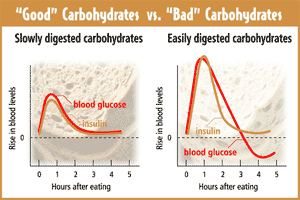
Recent research shows that certain carb-rich foods can cause extreme surges in blood sugar and insulin surges that contribute to weight gain and increase your risk of developing diabetes or heart disease. But carbs differ greatly in their potential to do this. The key variable is the Glycemic Index, a ranking of the foods according to how rapidly their sugars are released into the blood stream.
The body converts all digestible carbohydrates into glucose, the sugar that our cells use as fuel. When glucose molecules pass from the gut into the bloodstream, the pancreas releases insulin, a hormone that activates cells to absorb it. Muscle, fat and other cells then sponge the excess glucose from the blood, and insulin levels return to normal.
Carbohydrates that break down slowly in your body rate well or "low" on the Glycemic Index. On the other hand, carbs that break down too quickly and cause your insulin levels to spike and your body to store fat are given higher glycemic values. These “bad” carbs also leave you hungry soon after a meal, so if you’re looking to lose weight, you should seek to incorporate as many “good” carbs with low glycemic values as possible to keep your blood sugar levels stable and you metabolism burning strong.
The concept of a Glycemic Index emerged in the 1990s, when researchers at the University of Toronto showed that some foods (cornflakes or potatoes for example) raised blood sugar faster and higher than others (oatmeal or brown rice), placing greater demands on the insulin system. That discovery led to another more useful measurement called Glycemic Load, developed by a team from the Harvard School of Public Health. It takes into consideration both a food's Glycemic Index and how much carbohydrate the food delivers in a single serving.
Most fruits, vegetables, beans and whole grains have low glycemic loads: their sugars enter the bloodstream gradually, triggering only a moderate rise in insulin. But when fruits are squeezed into juices, or grains are pulverized into fine flour, they become the equivalent of sugar water.
 Daily Calorie Consumption Predictions for Women
|
Body weigh |
Resting calories: |
Low activity: |
Medium activity: |
High activity: |
|
100 |
1,120 |
1,450 |
1,570 |
1,680 |
|
110 |
1,150 |
1,490 |
1,600 |
1,720 |
|
120 |
1,190 |
1,550 |
1,670 |
1,780 |
|
130 |
1,220 |
1,580 |
1,700 |
1,830 |
|
140 |
1,250 |
1,630 |
1,750 |
1,880 |
|
150 |
1,280 |
1,660 |
1,800 |
1,920 |
|
160 |
1,320 |
1,720 |
1,850 |
1,980 |
|
170 |
1,350 |
1,750 |
1,890 |
2,000 |
|
180 |
1,380 |
1,790 |
1,930 |
2,070 |
|
190 |
1,420 |
1,850 |
1,990 |
2,100 |
|
200 |
1,450 |
1,880 |
2,030 |
2,180 |
|
210 |
1,480 |
1,950 |
2,050 |
2,200 |
|
220 |
1,513 |
1,970 |
2,100 |
2,270 |
|
230 |
1,540 |
2,000 |
2,160 |
2,300 |
|
240 |
1,580 |
2,050 |
2,200 |
2,400 |
|
250 |
1,610 |
2,090 |
2,250 |
2,410 |
|
260 |
1,640 |
2,130 |
2,300 |
2,460 |
|
270 |
1,676 |
2,170 |
2,350 |
2,500 |
|
280 |
1,710 |
2,220 |
2,400 |
2,560 |
|
290 |
1,740 |
2,260 |
2,440 |
2,600 |
|
300 |
1,770 |
2,480 |
2,500 |
2,660 |
Body Mass Index And Body Weight
BMI is an over hundred year old body composition measure based on the division of a person's weight (in kilograms) by the person's height (in meters squared). The higher the result, the more overweight you allegedly are. The Body Mass Index is reliable only as far as a very average citizen is concerned and that's probably why so many government agencies love it. People exceeding a BMI of 25 are considered overweight. Obesity starts at a BMI of 30 and extreme obesity at a BMI of 40.
Before you begin worrying that your BMI is too high please take a look at your physical structure. Do you have thick bones? Do you have a lot of muscle? All advanced bodybuilders would be qualified - according to this ancient system - as overweight if not obese; and so would persons with naturally heavy skeletons.
The U.S. Department of Agriculture, and the U.S. Department of Health and Human Services published, quite some time ago (1990), a very sensible range of appropriate weights for adults 19 and over. Many experts still recognize that calculation as one of the best ever. Get your height, weight and body characteristics data and compare them with the table below:
Appropriate Weights for Adults 19 and Older
|
Height 5'3" |
Total Range 107-152 |

Fitness Classic Nutrition Dilemmas Exercise Ideas
Strength Training Healthy Mind Fitness Opinions Archive
Copyright (c) 2000-2023 Fitness Classic. All rights reserved.